
Yihao Classroom
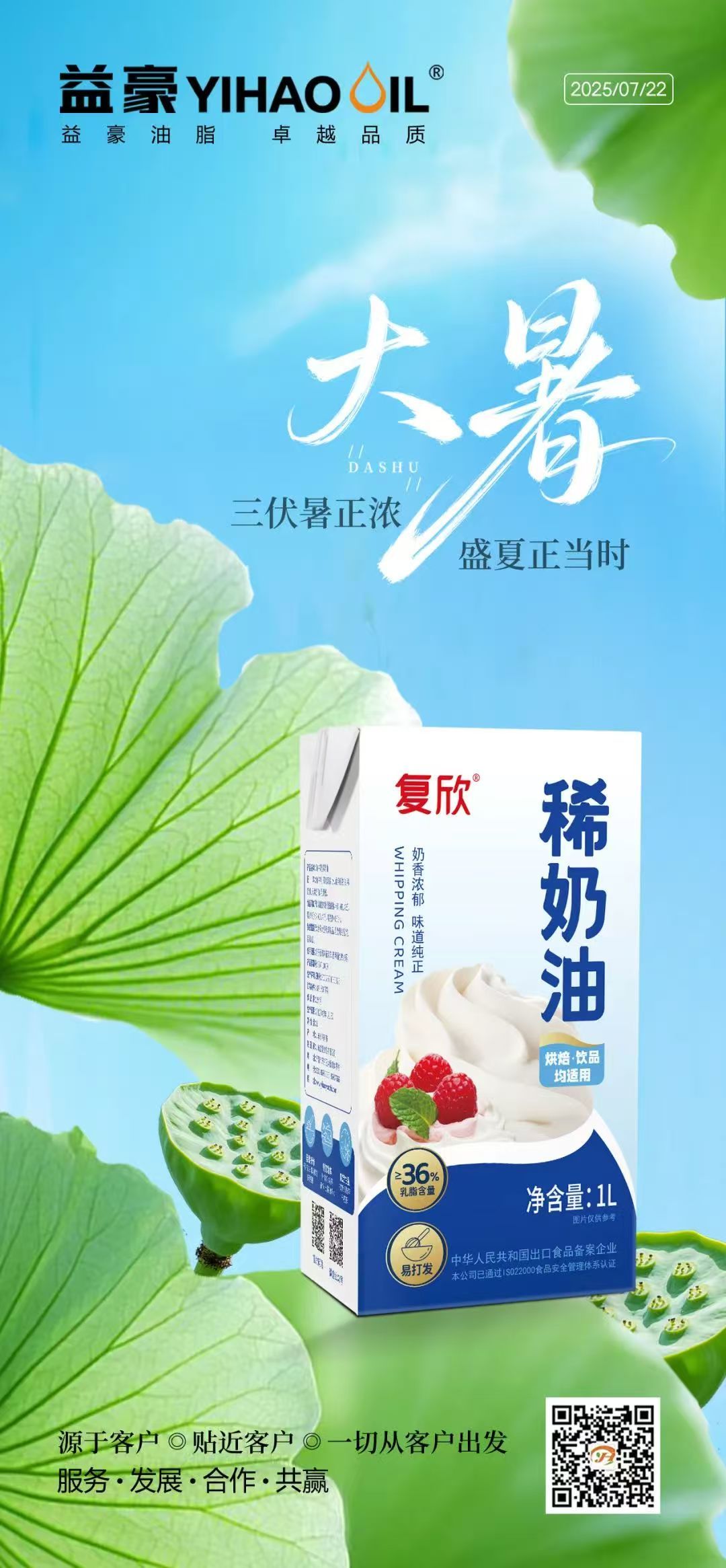
Yihao/Today is the Great Heat/The hottest part of summer, the height of summer
Great Heat is the twelfth solar term in the 24 solar terms, and also the last solar term of summer. When the handle of the Big Dipper points to the constellation Wei, the sun's ecliptic longitude is 120°. It falls on July 22-24 in the Gregorian calendar. "Heat" means hot, and Great Heat refers to the extreme heat. Compared to Lesser Heat, Great Heat is even hotter, and it is the time of year with the strongest sunlight and the hottest weather. "Damp heat" reaches its peak at this time. Climate characteristics of Great Heat: high temperature, thunderstorms, and frequent typhoons.
During the Great Heat solar term, the sunlight is intense, and the weather is hot, humid, and rainy. Although it is inevitably difficult to endure the damp heat, it is very beneficial to the growth of crops, which grow fastest during this period.
Since ancient times, there has been a folk custom of drinking herbal tea (Fucha) during the Great Heat and Sanfu days; Fucha, as the name suggests, is tea drunk during the Sanfu days. This tea, brewed from Chinese herbal medicine, has a cooling and heat-clearing effect. In addition, there are customs such as burning Fu incense and sun-drying Fu ginger. "Great Heat" is the hottest and most humid time of the year, and the focus of health preservation at this time is "heat prevention" and "dehumidification".
Characteristics of the Great Heat Solar Term
The Great Heat solar term falls during the "Sanfu" period, which is the time of year with the most sunshine and the highest temperatures in China. Most parts of the country experience drought and little rain, and the temperature in many areas reaches over 35 degrees Celsius, commonly known as the "three major furnaces" at their hottest.
In the areas along the middle and lower reaches of the Yangtze River north of South China, such as Jiangsu, Zhejiang, and Jiangxi, it is a hot and dry season, with rain as precious as gold. There are sayings such as "rain in Lesser Heat is like silver, rain in Great Heat is like gold," "more rain in Sanfu, more rice in the granary," "abundant rain in Sanfu, abundant grain and cotton," and "no drought in Sanfu, an increase of one dan per mu." Just as Zuo Heshuai's poem says: "The sun is strong in Sanfu, the heat is suffocating, sitting idly, annoyed by the quiet flies and mosquitoes. Even if war drums rise in the clouds, arrows shoot into the lotus pond like scattered gold." If there is rain before and after Great Heat, it indicates that there will be more rain later. There is a saying: "Rain in Great Heat means more rain, sufficient autumn water; no rain in Great Heat means less rain, and worries about water shortage."
In the southwestern region of South China, although high temperatures are also most frequent, rainfall is most abundant, and thunderstorms are most common, making it the season with the most thunderstorms. There is a proverb here: "East flash, no half drop; west flash, too late to escape." It means that in the summer afternoon, if lightning appears in the east, the rain will not fall here; if lightning appears in the west, the rain will come very quickly, and it will be too late to avoid it.
Based on whether it is hot or not during Great Heat, there are many agricultural proverbs that predict the later weather: short-term predictions include "hot Great Heat, rest in the field; cool Great Heat, full pond"; medium-term predictions include "hot Great Heat, cool autumn"; long-term predictions include "Great Heat is terribly hot, no frost for four months," "Great Heat is not hot, winter is not cold," and "Great Heat is not hot, winter will be bad".
Customs of the Great Heat Solar Term
Drinking Shu Yang: Many areas in Shandong have the custom of "drinking Shu Yang" (drinking mutton soup) on the day of Great Heat. In Zaozhuang City, many citizens go to local mutton soup restaurants to "drink Shu Yang" on this day.
Drinking Fucha: From ancient times to the present, there has been a folk custom of drinking Fucha during the Great Heat and Sanfu days. Fucha, as the name suggests, is tea drunk during the Sanfu days. This tea, brewed from more than ten kinds of Chinese herbal medicines such as honeysuckle, summer savory, and licorice, has a cooling and heat-clearing effect.
Cricket Fighting: Great Heat is the season with the most crickets in the countryside. In some parts of China, people enjoy cricket fighting after tea and dinner.
Eating Xiancao: Many places in Guangdong have the custom of "eating Xiancao" during the Great Heat. Xiancao, also known as mesona chinensis, is a herbaceous plant of the genus Mesona in the family Lamiaceae, and is an important resource for both medicine and food. Because of its magical summer-heat relieving effect, it is known as "immortal grass." The dried stems and leaves can be made into burnt Xiancao, called Liangfen in Guangdong, a summer dessert.
Sun-drying Fu Ginger: Fu ginger originated in Shanxi and Henan provinces of China. During the Sanfu days, people slice or juice ginger and mix it with brown sugar, put it in a container, cover it with gauze, and sun-dry it. After thorough mixing, it is eaten and has a miraculous effect on cold stomach, colds and coughs, and has a warming and health-preserving effect. When the body has eaten cold things, been caught in the rain, or stayed in an air-conditioned room for a long time, drinking Fu ginger can promptly eliminate various discomforts caused by the body's coldness.
Burning Fu Incense: The temperature is highest during the Great Heat solar term, crops grow fastest, and droughts, floods, and wind disasters are most frequent in most areas. Harvesting, planting, drought resistance, drainage, typhoon prevention, and field management tasks are heavy; therefore, people burn incense to pray for good weather and a bumper harvest. There is also a saying that is close to the moxibustion of traditional Chinese medicine, in which specific acupoints are fumigated with medicinal incense during the Sanfu days to treat various stubborn diseases.
Eating Pineapple: During Great Heat, there is a custom of eating pineapple in Taiwan, and people believe that pineapples are the best at this time of year. In addition, the Minnan pronunciation of pineapple is the same as "Wanglai" (prosperity), so it is also used as a symbol of praying for peace, good fortune, and business prosperity.
Sending the "Great Heat Boat": The activity of sending the "Great Heat Boat" during Great Heat has a history of several hundred years in the coastal areas of Taizhou, Zhejiang Province. The "Great Heat Boat" is built according to the reduced scale of the old three-masted sailing ship, and various sacrificial offerings are loaded in the boat. After the activity begins, more than 50 fishermen take turns carrying the "Great Heat Boat" through the streets, with drums and music, firecrackers, and crowds of people praying along the streets. The "Great Heat Boat" is finally transported to the wharf for a series of prayer ceremonies. Then, the "Great Heat Boat" is pulled out of the fishing port by a fishing boat and then set on fire at sea, allowing it to sink and float, thus blessing people with a bumper harvest and a healthy life. Taizhou Jiaojiang people also have the custom of eating ginger juice egg during the Great Heat solar term. Ginger juice can remove moisture from the body, and ginger juice egg "supplements people." Some elderly people also like to eat chicken porridge, which is said to supplement yang.
Celebrating Great Heat
On the Greater Heat day, Putian families have the custom of eating lychees, mutton, and rice wine, called "passing the Greater Heat". On the Greater Heat day, relatives and friends often give lychees and mutton as gifts to each other.
Yihou Oil - Excellent Quality
Yihou YIHAO OIL
🌼The 24 Solar Terms: Greater Heat
🏝The hottest days of Sanfu, summer is in full swing
Latest developments

WeChat Public Number
Shandong Yihao Food Co., Ltd
Telephone:86-531-86933666
Fax:86-531-86937666
Mailbox:yihaoyouzhi@163.com
Website:www.yihaoyouzhi.com
Address: Daqiao Economic Development Zone, Tianqiao District, Jinan City (Yihao Food Industrial Park)